
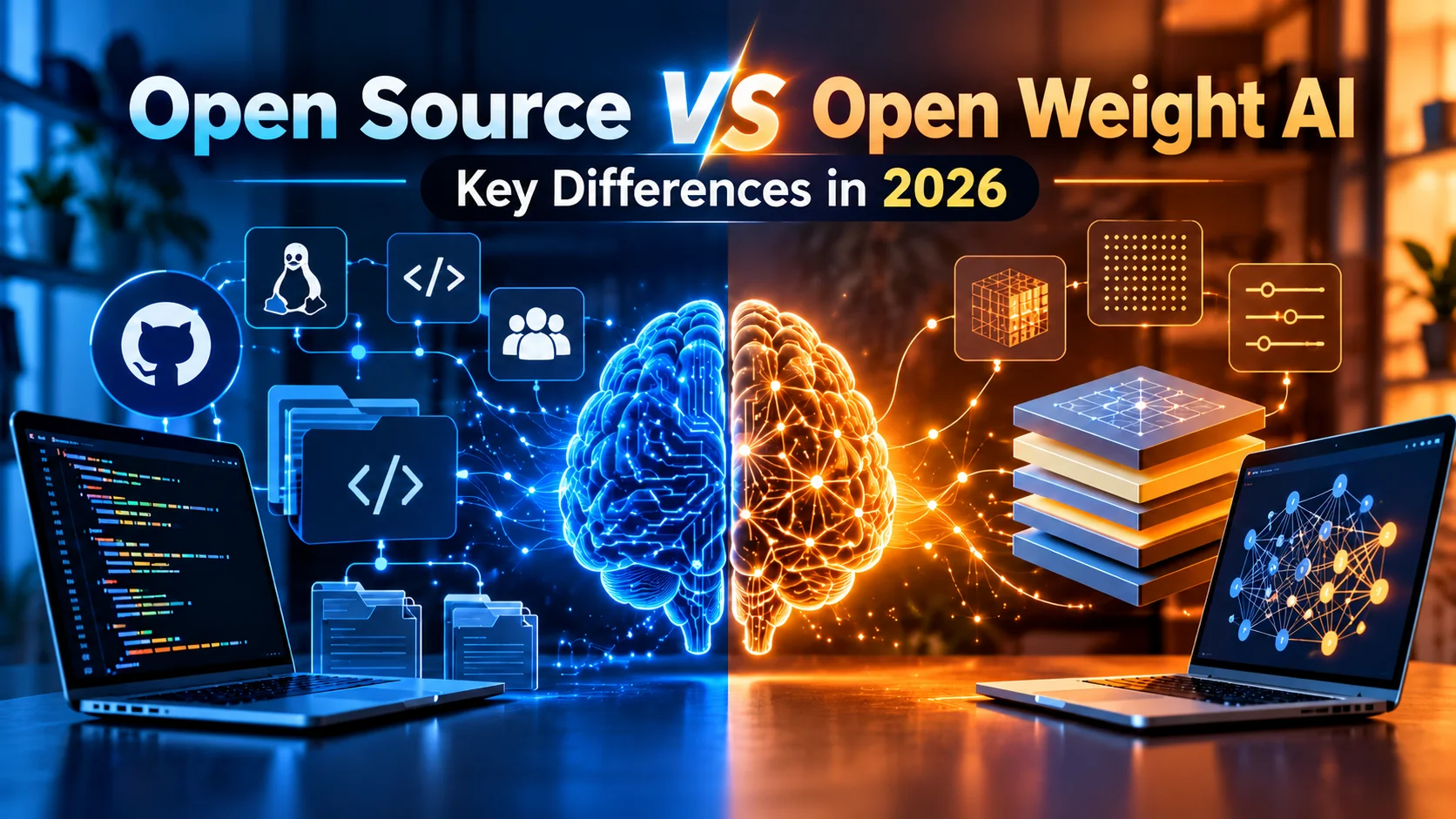
Artificial intelligence is changing how businesses automate workflows, develop products, analyze information, and serve customers. However, as more AI models become available, one important question remains: should businesses choose open source AI, open weight AI, or closed AI models?
Although these terms are often used interchangeably, they represent different levels of access, flexibility, and control. The distinction matters when selecting an AI model for commercial applications, protecting sensitive information, managing infrastructure costs, or building customized solutions.
For developers, founders, and technology leaders, understanding open source vs open weight AI is essential for making informed decisions about AI adoption. An accessible model may offer greater flexibility, but its license, training-data transparency, and deployment requirements determine how useful it will be in practice.
This guide explains the differences between these AI models, their advantages and limitations, and how businesses can select the right approach for their needs.
What Is Open Source AI?
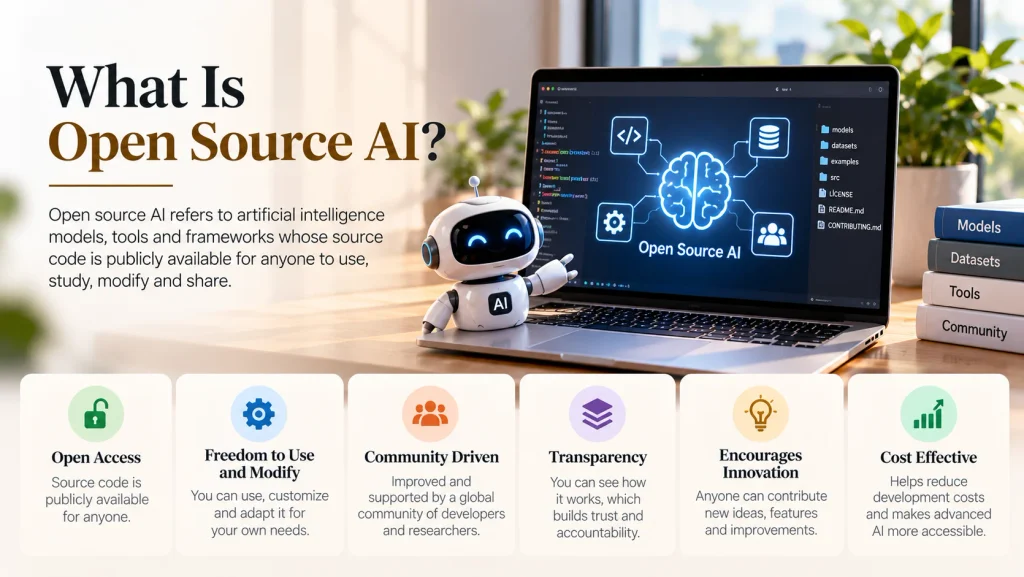
Open source AI refers to AI systems that provide the components and information necessary to understand, study, modify, and redistribute the model under an appropriate open license.
According to the Open Source Initiative’s Open Source AI Definition, this includes model parameters, the complete code needed to run and modify the system, and sufficiently detailed information about training data to enable others to build a substantially equivalent system.
The primary advantage is transparency. Developers can examine how a model was developed, customize it for specific applications, and investigate its limitations.
Key Benefits of Open Source AI
- Transparency: Access to relevant training information and code supports independent evaluation.
- Customization: Developers can modify and adapt the model for specialized requirements.
- Reproducibility: Greater access to development information helps researchers investigate model behavior.
- Flexibility: Organizations can build solutions without depending entirely on a single AI provider.
Open source AI is particularly useful for research, model evaluation, and projects that require greater control over development and auditing.
However, access to source code and training information does not automatically guarantee accuracy, security, or regulatory compliance. These factors still require independent evaluation.
What Is Open Weight AI?
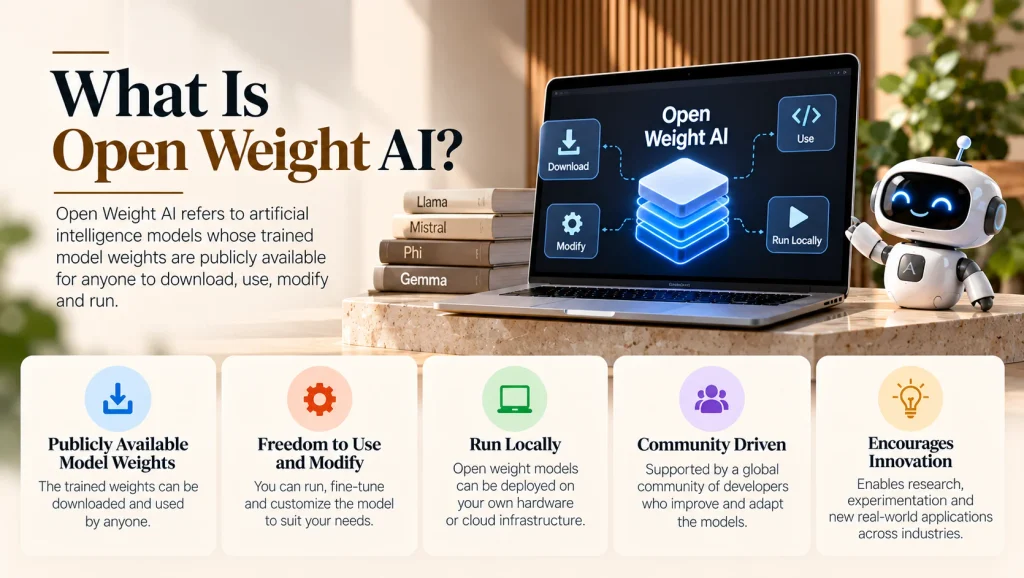
An open weight AI model makes its trained parameters, commonly called weights, available for download. Depending on the model and its license, developers can run it on their own infrastructure, fine-tune it, and integrate it into commercial applications.
Unlike fully open source AI, an open weight model does not necessarily disclose its complete training dataset or training process.
Popular examples of open weight models include OpenAI’s gpt-oss, Google’s Gemma 4, and eligible Apache 2.0 releases from the Qwen family. Their precise permissions depend on the specific model version and its published license.
Key Benefits of Open Weight Models
- Deployment flexibility: Models can run on local computers, private servers, or cloud infrastructure.
- Greater data control: Self-hosting can keep prompts and documents within an organization’s environment.
- Customization: Supported models can be adapted using techniques such as fine-tuning and LoRA.
- Infrastructure choice: Businesses can select hardware and hosting arrangements based on workload requirements.
Open weight models are attractive to organizations that want to build AI-powered applications without training a foundation model from scratch.
Nevertheless, downloading a model does not mean that every commercial use, redistribution method, or model-hosting service is automatically permitted.
Open Source vs Open Weight AI: What Is the Difference?
The main difference is the amount of information made available about a model’s development.
| Comparison Factor | Open Source AI | Open Weight AI |
| Model weights | Available | Available |
| Training code | Available under the applicable definition | Not necessarily available |
| Training-data information | Sufficient information to recreate a substantially equivalent system | May be limited or unavailable |
| Customization | Broad flexibility | Depends on the model and license |
| Commercial use | Permitted under a compliant open license | Depends on the specific license |
| Self-hosting | Generally possible | Generally possible |
| Training transparency | Greater | More limited |
| Best suited for | Research, auditing, and transparent development | Private deployment, customization, and practical AI applications |
The difference can be understood through a simple analogy: open weight gives you the finished dish, while open source gives you the dish, the recipe, and information about the ingredients.
Both approaches can be valuable. The right choice depends on whether a business prioritizes transparency, customization, privacy, or deployment convenience.
What About Source-Available and Closed AI Models?
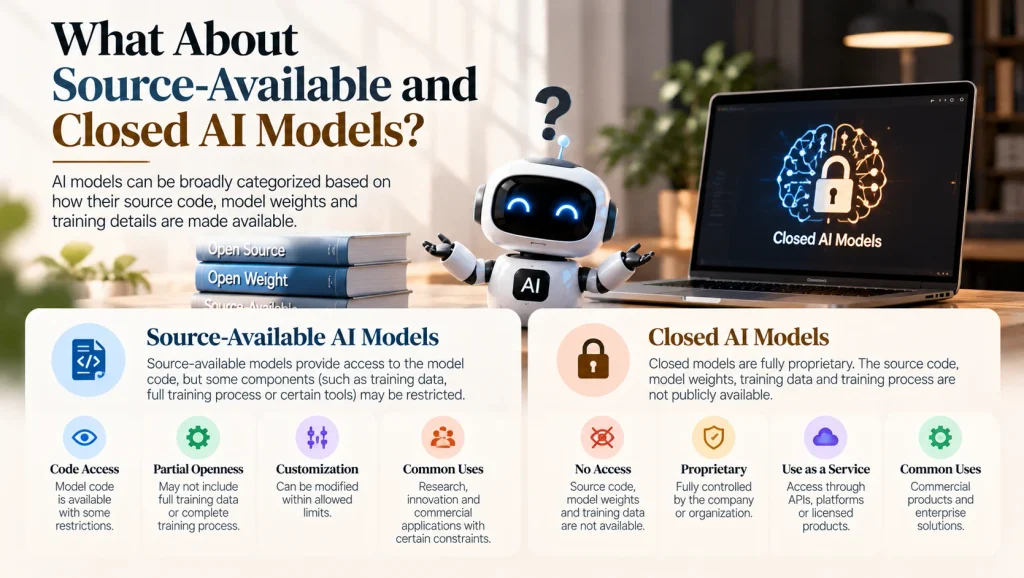
Not every model fits neatly into the open source or open weight categories. Two additional categories are important when evaluating AI solutions.
Source-Available AI
Source-available models provide downloadable weights or other model components but impose additional restrictions through their licenses. These may include revenue thresholds, user-count requirements, branding obligations, acceptable-use policies, or non-commercial restrictions.
For example, Meta’s Llama 4 uses a custom community license rather than an OSI-compliant open source license.
These models can be useful, but businesses should review the complete license before integrating them into products or offering AI services commercially.
Closed AI Models
Closed AI models are accessed primarily through hosted applications or APIs. Their weights and internal development resources generally remain under the provider’s control.
This approach can simplify implementation because businesses do not need to manage model hosting or GPU infrastructure themselves.
Closed models are useful when teams need advanced capabilities, rapid prototyping, or a managed service with minimal infrastructure work. However, they may introduce recurring usage costs, vendor dependency, and additional considerations around data retention and privacy.
Open Weight Models vs Closed AI: Which Is More Cost-Effective?
AI costs depend on usage, model size, infrastructure, operational requirements, and the complexity of the application.
Open weight models can reduce costs by allowing businesses to select smaller models, use competitive hosted inference services, or operate models on existing infrastructure. At higher and more predictable workloads, self-hosting may offer better unit economics.
Closed AI APIs, meanwhile, can be economical for smaller projects because they eliminate the need to purchase hardware and maintain model-serving infrastructure.
Before choosing a deployment method, businesses should evaluate:
- API expenses: Calculate expected input and output tokens, requests, and monthly usage.
- Hardware requirements: Estimate GPU memory, compute capacity, storage, and electricity.
- Engineering costs: Include integration, testing, monitoring, and maintenance.
- Scaling needs: Consider how costs change as the number of users and requests increases.
The cheapest model is not necessarily the most cost-effective solution. A slightly more expensive model that produces reliable results with fewer retries may deliver better overall value.
Privacy and Security: Does Open Weight AI Keep Data Private?
Privacy depends primarily on where a model runs and how the surrounding application handles information—not simply on whether the model is open weight.
When a business deploys a model on its own infrastructure, it can keep prompts, documents, and generated outputs within its controlled environment. This can be valuable for organizations handling confidential business information or personal data.
However, self-hosting also transfers security responsibilities to the organization.
Businesses should implement appropriate access controls, encryption, logging policies, vulnerability management, and model evaluation. They should also assess risks such as inaccurate outputs, prompt injection, biased responses, and insecure integrations.
When using a hosted API, organizations should review the provider’s data-retention policies, training practices, processing locations, contractual safeguards, and applicable legal obligations.
For Indian businesses, deployment decisions should also account for the Digital Personal Data Protection Act and applicable rules. Using an on-premise model can support data-control objectives, but it does not automatically establish legal compliance.
How Can Businesses Use Open Weight AI Models?
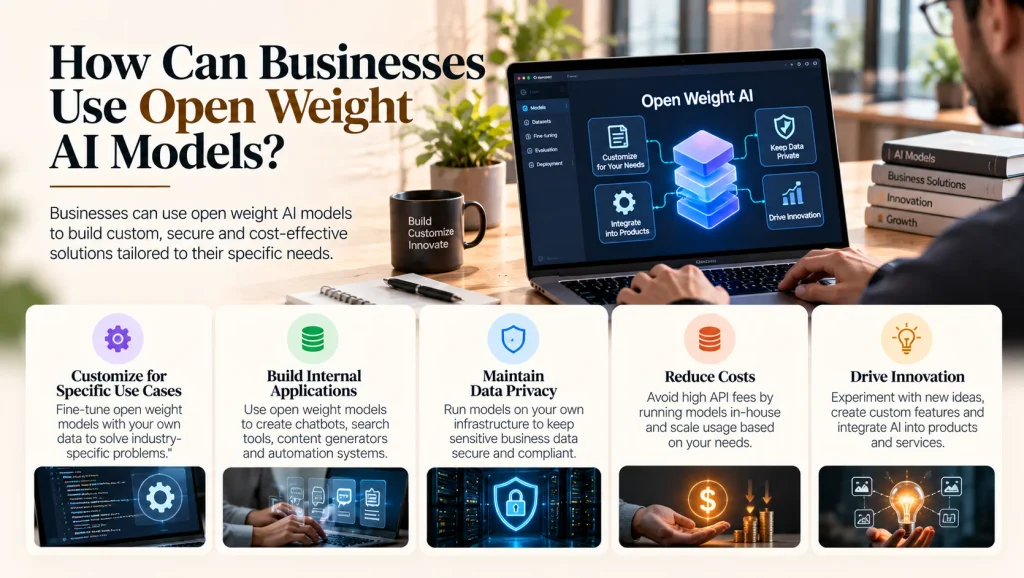
Open weight models support a wide range of practical business applications.
1. AI-Powered Customer Support
Businesses can develop conversational assistants that answer frequently asked questions, retrieve relevant documentation, and route complex queries to human employees.
Retrieval-augmented generation (RAG) can help these assistants reference approved company information instead of relying entirely on the model’s pretrained knowledge.
2. Document Processing and Knowledge Management
Organizations can use language models to summarize reports, extract information from contracts, categorize documents, and help employees search internal knowledge bases.
For sensitive documents, private deployment can offer greater control over where information is processed.
3. Product Catalog Management
Retailers and marketplaces can use AI to classify product images, extract attributes, generate product descriptions, and organize large catalogs.
For example, a building-materials marketplace could use computer vision and language models to identify product characteristics and draft descriptions for human review. This can reduce repetitive work while maintaining a structured catalog.
4. Business Workflow Automation
AI models can support workflows such as email classification, report generation, lead qualification, and information extraction. Integrated with existing business systems, these capabilities can reduce manual effort and help teams process routine tasks more efficiently.
The success of each application depends on model performance, data quality, integration design, and appropriate human oversight.
How to Choose the Right AI Model for Your Business
Selecting an AI model should begin with the business problem rather than the model’s popularity.
Consider these five questions before making a decision:
- What are your requirements? Determine whether you need advanced reasoning, document processing, image recognition, or conversational capabilities.
- How sensitive is your data? Identify whether information can be processed by an external provider or must remain within controlled infrastructure.
- What does the license allow? Review commercial-use permissions, redistribution conditions, attribution requirements, and service-hosting restrictions.
- What is your expected workload? Estimate usage and compare API costs against hosting and maintenance expenses.
- How will performance be measured? Test candidate models against real business tasks, accuracy requirements, latency targets, and security expectations.
Many organizations benefit from a hybrid strategy. Open weight models can handle routine, high-volume, or privacy-sensitive tasks, while hosted models can support applications requiring capabilities that a locally deployed model cannot reliably deliver.
This approach also reduces dependence on a single provider when applications are designed to support model switching.
How A3Bees Innovation Helps Businesses Adopt AI
Choosing a model is only one part of building a successful AI solution. Businesses also need to connect the model with their data, workflows, applications, and performance goals.
A3Bees Innovation provides AI-focused services spanning generative AI, natural language processing, computer vision, and AI-powered business automation. Its solutions are designed to help organizations identify practical AI opportunities and develop applications aligned with their requirements.
Depending on the project, this can include:
- Developing AI assistants and conversational applications.
- Automating repetitive business processes and document workflows.
- Applying computer vision to image analysis and product-related tasks.
- Building generative AI applications for content creation and business productivity.
- Evaluating AI implementation options against operational needs and expected outcomes.
The appropriate architecture may use open source models, open weight models, hosted APIs, or a combination of these approaches. Model selection should follow an assessment of licensing, performance, security, infrastructure, and long-term maintenance requirements.
Businesses exploring AI adoption can visit A3Bees Innovation to discuss their objectives and identify potential implementation opportunities.
Conclusion
The debate around open source vs open weight AI is not about identifying one universally superior approach. It is about understanding the trade-offs between transparency, customization, cost, privacy, and operational complexity.
Open source AI is valuable when access to development information and reproducibility are important. Open weight models provide practical flexibility for businesses that want to deploy and customize AI without training a foundation model themselves. Source-available and closed models offer other options, each with its own licensing and operational considerations.
Before choosing a model, assess the actual license, test performance against real workloads, calculate total operating costs, and establish appropriate security controls.
With a well-defined strategy and the right technical implementation, businesses can turn AI capabilities into practical applications that support productivity, better decisions, and sustainable growth.