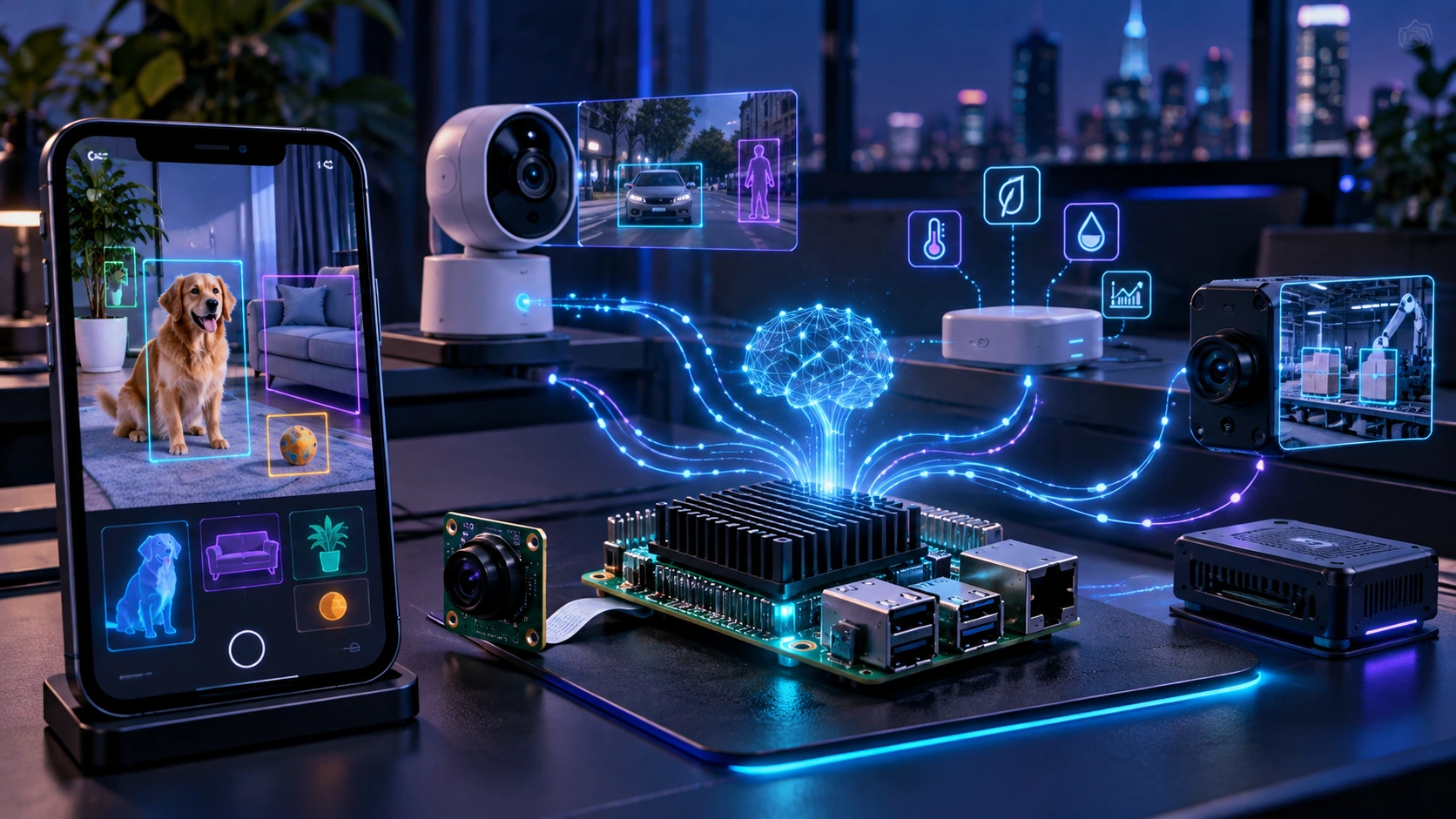
Computer vision is moving closer to where images and video are actually captured. Instead of sending every camera frame to a remote cloud server, edge AI computer vision allows devices to analyze visual data locally. In 2026, this is becoming practical across smartphones, Raspberry Pi systems, IoT devices, industrial cameras, and dedicated AI hardware.
The biggest change is the rise of small vision-language models (VLMs). Models such as SmolVLM2 and Moondream2 make it possible to combine image understanding with natural-language interaction on comparatively small devices. The result is faster inference, improved privacy, offline operation, and potentially lower long-term cloud costs.
This shift is particularly relevant for embedded developers, ML engineers, IoT teams, Raspberry Pi enthusiasts, and enterprises looking for scalable on-device computer vision solutions.
What Is Edge AI for Computer Vision?
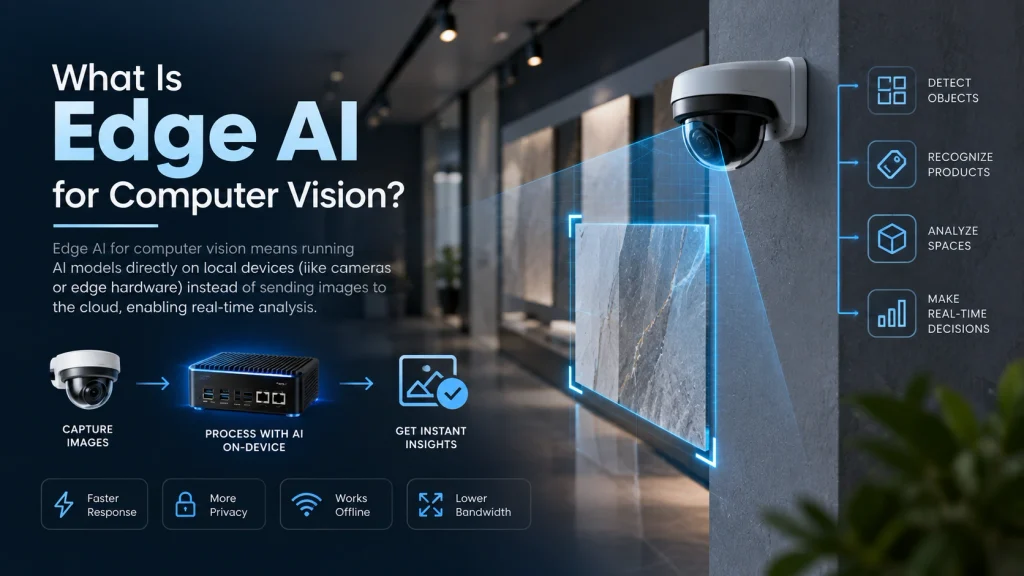
Edge AI for computer vision means running AI-powered image or video analysis directly on a local device rather than sending visual data to a cloud server.
A camera connected to a Raspberry Pi, smartphone, industrial computer, or AI accelerator can detect objects, recognize scenes, read text, classify products, or interpret images locally. This reduces dependence on an internet connection and can significantly reduce the delay between capturing an image and receiving an AI result.
The approach is becoming more capable as smaller models, specialized NPUs, and AI accelerators make local inference practical. The outline highlights the growth of edge AI and the increasing importance of computer vision within edge workloads.
Why Run Vision AI on the Edge?
Cloud AI remains useful, but sending every image or video frame to a remote API is not always the best architecture. On-device computer vision provides four major advantages.
1. Lower Latency
A cloud-based vision application must capture data, transmit it, process it remotely, and receive the response. Edge inference eliminates much of this network round trip.
For applications such as industrial inspection, robotics, security monitoring, and real-time assistance, milliseconds can matter.
2. Better Privacy
With on-device VLMs, sensitive images can remain on the device. This can be especially valuable for healthcare, retail environments, workplaces, and applications involving personal information.
3. Reduced Cloud Costs
At large scale, continuously processing images through cloud APIs can become expensive. Running inference locally shifts some of that cost toward hardware and deployment.
For an organization processing millions of images, the economics can make edge inference particularly attractive.
4. Offline Reliability
An edge AI system can continue working when connectivity is unreliable or unavailable. This is useful for agriculture, factories, remote locations, mobile devices, and IoT deployments.
The trade-off is that teams must manage local hardware, model optimization, memory requirements, and software deployment.
Edge AI Hardware Landscape in 2026
There is no single best device for computer vision. The right hardware depends on model size, performance requirements, power consumption, budget, and whether the application is a prototype or production system.
| Hardware | Best For | Key Advantage |
| Smartphone | Mobile vision AI | Built-in camera + NPU |
| Raspberry Pi | Prototyping and IoT | Low cost and flexible |
| Raspberry Pi + AI HAT | Local vision workloads | Dedicated acceleration |
| NVIDIA Jetson | Robotics and advanced CV | Strong GPU/AI ecosystem |
| AI Workstation | Large models and development | Maximum compute |
The hardware landscape now ranges from inexpensive edge devices to powerful AI computers. The outline specifically highlights Raspberry Pi systems, NVIDIA Jetson Orin platforms, Hailo-8 accelerators, smartphones, and workstation-class hardware.
For example, the NVIDIA Jetson Orin Nano Super is highlighted as a platform capable of running sophisticated local AI workloads, while Hailo-8 focuses on efficient vision acceleration with relatively low power consumption.
Small VLMs That Can Run on Edge Devices

Vision-language models combine computer vision with language understanding. Instead of simply answering “what object is this?”, a VLM can potentially interpret an image and respond to natural-language questions about it.
The most interesting development for edge AI is the move toward smaller models.
SmolVLM2
SmolVLM2 is designed for lightweight multimodal workloads and is particularly interesting for devices with constrained computing resources. The outline positions the 256M version as a very small video-language model suitable for phones and Raspberry Pi-class environments.
Moondream2
Moondream2 is another lightweight vision-language model suited to experimentation and local image understanding. It is especially relevant to Raspberry Pi projects and embedded development.
MagicVL-2B
MagicVL-2B demonstrates the direction of efficient VLM development: reducing the computational and power requirements of visual reasoning while maintaining useful accuracy.
Gemini Nano and Apple Intelligence
Smartphones are becoming another major edge AI platform. Google’s Gemini Nano and Apple’s on-device intelligence capabilities demonstrate how increasingly capable AI can operate locally on mobile hardware. The outline identifies mobile developers as an important audience for this area.
How Do I Quantise a Model for Edge Deployment?
Quantization reduces the numerical precision used by a model so it requires less memory and computational power. For example, an FP32 model can potentially be converted to INT8 or INT4 representations.
Think of it as compressing a high-resolution image: you reduce its size while attempting to preserve the information that matters.
Common optimization techniques include:
- INT8/INT4 quantization: reduces model size and computational requirements.
- Pruning: removes less important model parameters.
- Knowledge distillation: trains a smaller model to reproduce the behavior of a larger model.
- TensorRT: optimizes inference for NVIDIA hardware.
- llama.cpp: enables efficient local model execution in supported environments.
- ExecuTorch: supports optimized AI inference on edge devices.
- MLX: provides an Apple-focused framework for machine-learning workloads.
These techniques are central to small VLM edge deployment, because an accurate model that cannot fit into available memory or meet latency requirements is not useful in a real device.
Can a Raspberry Pi Run a Vision-Language Model?
Yes. A Raspberry Pi can run lightweight vision-language models, although performance depends heavily on the model, memory, optimization, and whether an accelerator is used.
A typical experimental setup could include a Raspberry Pi, camera, local VLM, and optional AI accelerator. The camera captures an image, the model processes it locally, and the application returns an interpretation without requiring a cloud API.
A simplified workflow looks like this:
Camera → Image preprocessing → VLM inference → Natural-language response
For more demanding applications, an AI accelerator can offload vision processing and improve inference performance.
The outline specifically recommends a Raspberry Pi 5 + accelerator-based workflow for experimenting with Moondream2 and live camera input.
Mobile Vision AI: Phones as Edge Devices
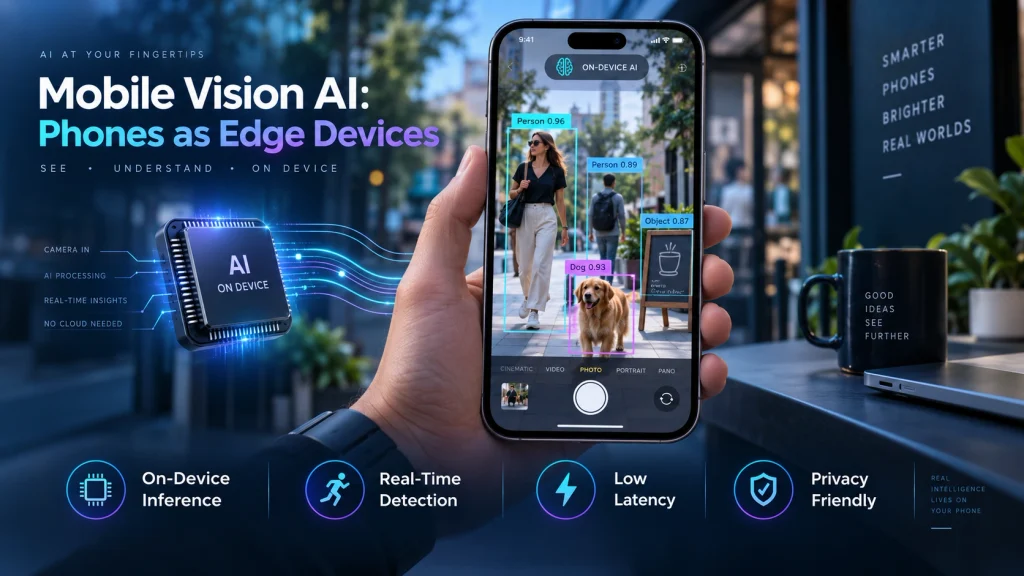
Smartphones may become the most widely deployed edge AI computers because they already contain cameras, powerful processors, GPUs, and NPUs.
In 2026, on-device computer vision can support tasks such as:
- Scene description
- Optical character recognition (OCR)
- Object recognition
- Real-time object tagging
- Image understanding
- Accessibility assistance
- Visual search
Android devices can use on-device models such as Gemini Nano, while Apple’s ecosystem provides increasingly capable local AI functionality.
The major advantage is that these capabilities can work directly alongside the phone’s camera without necessarily sending every frame to a remote server.
Real-World Edge AI Computer Vision Use Cases
Manufacturing
Factories can use edge vision systems for quality inspection, defect detection, counting, and production monitoring. Local inference can provide rapid responses without continuously streaming camera footage to the cloud.
Agriculture
Cameras connected to edge devices can monitor crops, identify visible plant issues, detect pests, or track agricultural conditions. Offline capability is particularly valuable in areas with limited connectivity.
Retail
Retailers can use computer vision for inventory monitoring, product recognition, shelf analysis, and customer-flow insights while processing visual information locally.
Healthcare
Edge computer vision can support selected diagnostic, monitoring, and workflow applications where privacy and low latency are important. Healthcare deployments require especially careful validation, security, and regulatory compliance.
Accessibility
Smartphones and wearable devices can use local vision AI to describe environments, identify objects, read text, and provide contextual assistance.
These use cases align with the broader edge AI landscape across manufacturing, retail, healthcare, smart environments, agriculture, and accessibility.
What Are the Limitations of Edge Vision AI?

Edge AI is powerful, but it is not automatically better than cloud AI.
The first limitation is model size. Larger VLMs generally require more memory and computing resources.
The second is accuracy. A smaller model may be faster but can sometimes produce less detailed or reliable results than a larger cloud model.
The third is hardware diversity. Deploying across phones, Raspberry Pi systems, Jetson devices, and dedicated accelerators introduces compatibility and optimization challenges.
There is also the issue of thermal and power constraints. A model that performs well during a five-minute test may behave differently when running continuously on a small battery-powered device.
For these reasons, edge deployments should be evaluated using real-world metrics such as latency, memory consumption, power usage, accuracy, and reliability rather than model size alone.
Edge AI vs. Cloud AI: Which Should You Choose?
The choice does not have to be either edge or cloud. Many modern architectures can use both.
| Requirement | Edge AI | Cloud AI |
| Low latency | Excellent | Depends on network |
| Offline operation | Excellent | Limited |
| Data privacy | Strong | Requires secure data transfer |
| Large models | Limited by hardware | Excellent |
| Easy scaling | Hardware-dependent | Strong |
| Upfront hardware | Required | Lower |
| Continuous local processing | Strong | Network-dependent |
A hybrid AI architecture can therefore be practical. A device might perform object detection locally while sending only selected images or complex requests to a cloud model.
The Future of On-Device Computer Vision
The direction of edge vision AI is clear: models are becoming smaller, hardware is becoming more AI-capable, and inference is moving closer to the camera.
This does not mean cloud AI will disappear. Instead, the two approaches are likely to work together.
Small task-specific models can handle fast, repetitive operations locally, while cloud models can provide deeper reasoning when required. The outline also points toward growing adoption of small, specialized models and increasingly capable edge processors.
For developers, this means computer vision is no longer restricted to expensive servers. A smartphone, Raspberry Pi, AI accelerator, or embedded computer can now become an intelligent vision system.
Final Takeaway
Edge AI computer vision in 2026 is moving from experimentation to practical deployment. Lightweight VLMs, efficient quantization, specialized accelerators, mobile NPUs, and platforms such as Raspberry Pi and Jetson are making local visual intelligence increasingly accessible.
If you are building an IoT product, robotics system, mobile application, industrial inspection solution, or computer vision prototype, the question is no longer simply “Can AI understand this image?”
It is increasingly:
“Can this device understand the image locally, quickly, privately, and reliably?”
For many applications, the answer in 2026 is yes.