Imagine uploading a photo of a damaged car and asking AI, “What parts need replacing?” Within seconds, the AI identifies the damaged bumper, estimates repair areas, and even explains the likely impact. Or imagine taking a picture of a restaurant menu written in another language and receiving an instant translation along with meal recommendations.
This is the power of Vision-Language Models (VLMs).
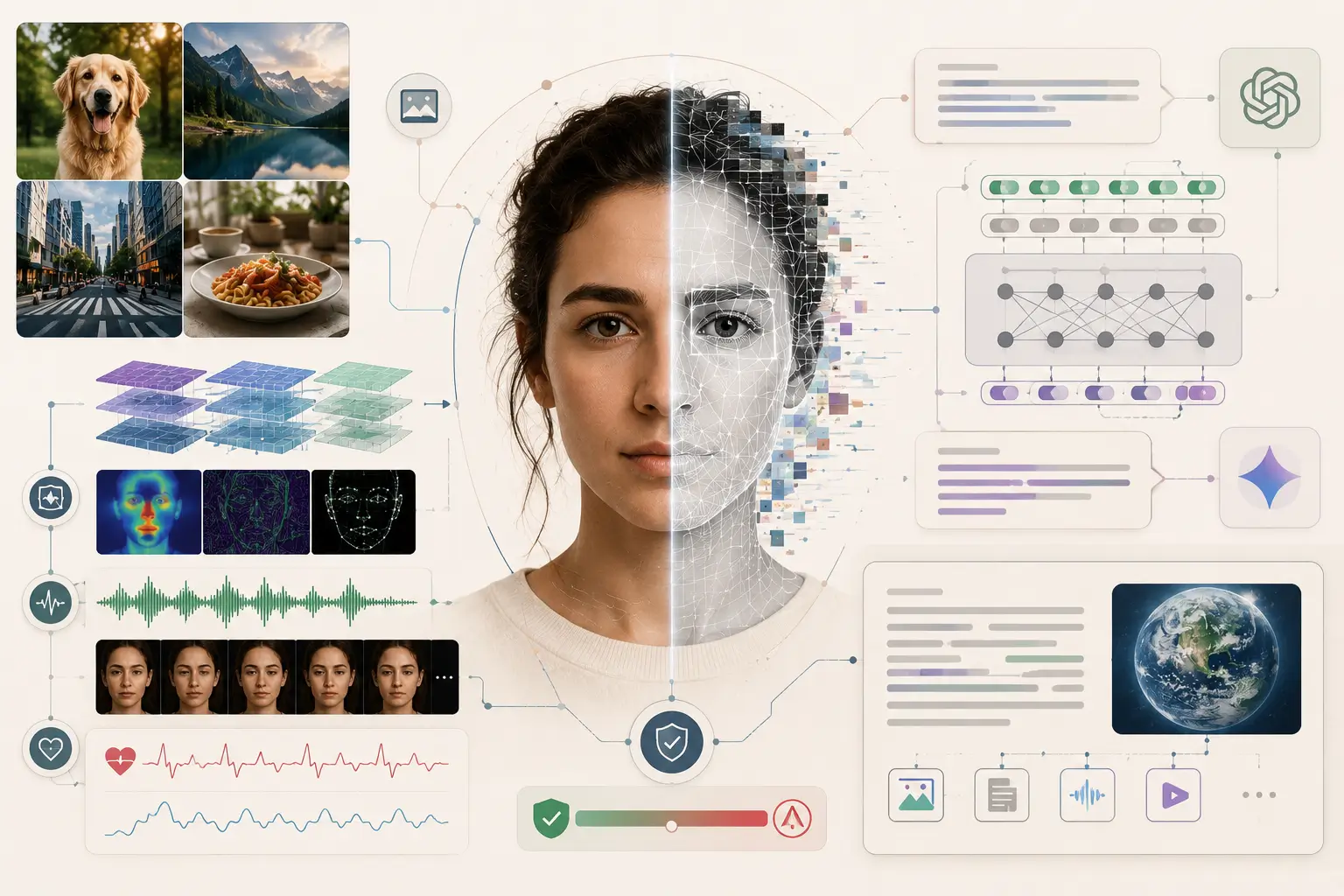
Unlike traditional AI systems that process either text or images independently, Vision-Language Models understand both simultaneously. They can analyze photographs, diagrams, documents, screenshots, charts, handwritten notes, and even complex scenes while responding naturally in human language.
The demand for multimodal AI is growing rapidly. Industry reports estimate the Vision-Language Model market will expand significantly over the next decade as businesses adopt AI-powered document understanding, healthcare imaging, autonomous vehicles, intelligent search, and accessibility solutions. Today, leading models like GPT-4o, Gemini 2.5 Pro, Claude, Qwen3-VL, and InternVL3 are redefining how machines perceive and interpret the visual world.
In this comprehensive guide, you’ll learn:
- What Vision-Language Models are
- How they work behind the scenes
- Why they’re different from traditional LLMs
- The best VLMs available in 2026
- Real-world business applications
- Future trends shaping multimodal AI
Key Takeaways
- Vision-Language Models combine image understanding with natural language processing.
- GPT-4o and Gemini can analyze images, charts, documents, and screenshots while answering complex questions.
- Modern VLMs use Vision Transformers and Large Language Models together.
- Businesses are using VLMs in healthcare, retail, education, manufacturing, accessibility, and document automation.
- Open-source models like Qwen3-VL and InternVL3 are becoming powerful alternatives to commercial AI.
What Are Vision-Language Models?

A Vision-Language Model (VLM) is an artificial intelligence system that understands both images and text within a single model.
Think of a human looking at a photograph while answering questions about it. A VLM works similarly. It “sees” the image, understands its content, and combines that understanding with language to generate intelligent responses.
For example, if you upload a picture of your living room and ask:
“Which wall color would match my furniture?”
A Vision-Language Model can identify the furniture, lighting conditions, wall layout, decorative style, and recommend suitable colors.
Unlike traditional image recognition software that simply labels objects, VLMs understand relationships, context, and intent.
They don’t just recognize a chair.
They understand:
- where the chair is
- what material it’s made from
- how it relates to surrounding furniture
- whether it matches the room’s interior style
This contextual understanding makes VLMs far more powerful than earlier computer vision systems.
Traditional AI vs Vision-Language Models

Earlier AI systems specialized in only one type of information.
A chatbot could answer text questions but couldn’t understand photographs.
An image recognition system could identify objects but couldn’t explain what it saw.
Vision-Language Models combine both abilities.
| Traditional AI | Vision-Language Models |
| Understands text only | Understands text and images together |
| Limited context | Rich contextual understanding |
| Separate image models | Unified multimodal reasoning |
| Object recognition | Scene understanding |
| Cannot answer visual questions | Can explain images naturally |
Think of traditional AI as someone who only speaks one language.
A Vision-Language Model is like someone fluent in multiple languages who can also interpret maps, charts, photographs, and handwritten notes.
How Do Vision-Language Models Work?
Although the underlying technology is complex, the basic workflow is surprisingly simple.
Step 1: Breaking the Image into Small Patches
Instead of analyzing an entire image at once, the AI divides it into hundreds of tiny squares called patches.
Imagine cutting a large photograph into puzzle pieces.
Each piece contains small amounts of visual information.
This allows the model to study every part individually.
Modern Vision Transformers (ViTs) use this approach because it captures both local details and global context.
Step 2: Converting Images into Numbers
Computers don’t understand photographs directly.
Each image patch is converted into numerical representations known as embeddings.
These embeddings describe:
- color
- texture
- edges
- shapes
- patterns
Think of this as translating a painting into a language computers understand.
Step 3: Combining Vision with Language
Once visual information becomes numerical data, it is passed to the language model.
The language model combines:
- image understanding
- user question
- previous conversation
- contextual reasoning
It then generates a meaningful response.
This is why GPT-4o can answer questions like:
- “What does this chart show?”
- “Summarize this invoice.”
- “Is this plant healthy?”
- “Describe this medical scan.”
The vision encoder acts as the AI’s eyes.
The language model acts as its brain.
Together, they create a system capable of understanding the visual world almost like humans do.
Top Vision-Language Models in 2026
| Model | Best For | Open Source |
| GPT-4o | Image conversations, documents, charts | No |
| Gemini 2.5 Pro | Video, coding, reasoning | No |
| Claude 3.5 Sonnet | Documents and long reports | No |
| Qwen3-VL | Research and development | Yes |
| InternVL3 | Industrial AI applications | Yes |
| LLaVA | Learning and experimentation | Yes |
GPT-4o
GPT-4o provides one of the most natural multimodal experiences available today. It excels at understanding images, interpreting documents, explaining charts, solving visual reasoning tasks, and maintaining conversational context.
Gemini 2.5 Pro
Gemini performs exceptionally well in video understanding, coding, scientific reasoning, and multimodal search. It is widely used for enterprise productivity and research.
Claude
Claude is particularly effective at analyzing lengthy documents, PDFs, technical diagrams, and structured reports while maintaining strong reasoning capabilities.
Qwen3-VL
Alibaba’s Qwen3-VL is among the strongest open-source Vision-Language Models available today, making it attractive for developers building custom AI solutions.
Real-World Applications of Vision-Language Models
Healthcare
Doctors use Vision-Language Models to analyze X-rays, MRI scans, pathology images, and medical reports. AI assists specialists by highlighting abnormalities and generating preliminary observations.
Retail & E-commerce
Customers can upload product photos and instantly find visually similar products, compare prices, and receive personalized recommendations.
Self-Driving Vehicles
Autonomous vehicles continuously interpret:
- road signs
- traffic lights
- pedestrians
- lane markings
- road hazards
using multimodal AI.
Accessibility
Vision-Language Models help visually impaired users by describing scenes, reading documents aloud, identifying products, and explaining surroundings in natural language.
Business Document Automation
Organizations use VLMs to extract information from:
- invoices
- contracts
- receipts
- financial reports
- insurance documents
This significantly reduces manual data entry and improves operational efficiency.
Education
Students upload handwritten notes, mathematical equations, engineering diagrams, and scientific illustrations to receive personalized explanations.
How Are Vision-Language Models Trained?

Training a VLM typically involves two stages.
Pre-training
The model learns from millions—or even billions—of image-text pairs collected from diverse sources.
This helps it understand how visual objects relate to language.
Fine-Tuning
The model is then optimized for specific tasks, such as:
- medical diagnosis
- legal document analysis
- product search
- visual question answering
- robotics
This specialization dramatically improves performance in industry-specific applications.
Future of Vision-Language Models
The next generation of VLMs will become even more capable.
Future developments include:
- Real-time video understanding
- AI agents capable of taking actions
- On-device multimodal AI
- Smarter robotics
- Better multilingual reasoning
- Improved scientific research assistants
- Enterprise workflow automation
As computing power increases, Vision-Language Models will move beyond understanding information to actively assisting users in completing complex tasks.
Conclusion
Vision-Language Models represent one of the biggest advancements in artificial intelligence. By combining computer vision with natural language understanding, they enable AI systems to interpret images, documents, videos, and real-world environments more naturally than ever before.
Whether you’re using GPT-4o to analyze charts, Gemini to understand videos, or Qwen3-VL to build custom AI applications, Vision-Language Models are transforming how humans interact with machines.
As multimodal AI continues to evolve, organizations that embrace Vision-Language Models today will be better positioned to automate workflows, improve customer experiences, and unlock new opportunities across industries.
Frequently Asked Questions
1. What is a Vision-Language Model?
A Vision-Language Model (VLM) is an AI model that understands both images and text simultaneously, allowing it to answer questions about visual content.
2. How does GPT-4o understand images?
GPT-4o converts images into numerical representations using a vision encoder before combining them with language understanding to generate responses.
3. What is the difference between a VLM and an LLM?
A Large Language Model processes only text, while a Vision-Language Model processes both images and text together.
4. Can Gemini understand images?
Yes. Gemini can analyze images, videos, diagrams, screenshots, and documents while answering complex questions in natural language.
5. Which is the best open-source Vision-Language Model?
Qwen3-VL and InternVL3 are among the strongest open-source Vision-Language Models available in 2026.
6. What industries use Vision-Language Models?
Healthcare, finance, manufacturing, retail, education, autonomous vehicles, accessibility technology, legal services, and enterprise automation all benefit from Vision-Language Models.