Introduction
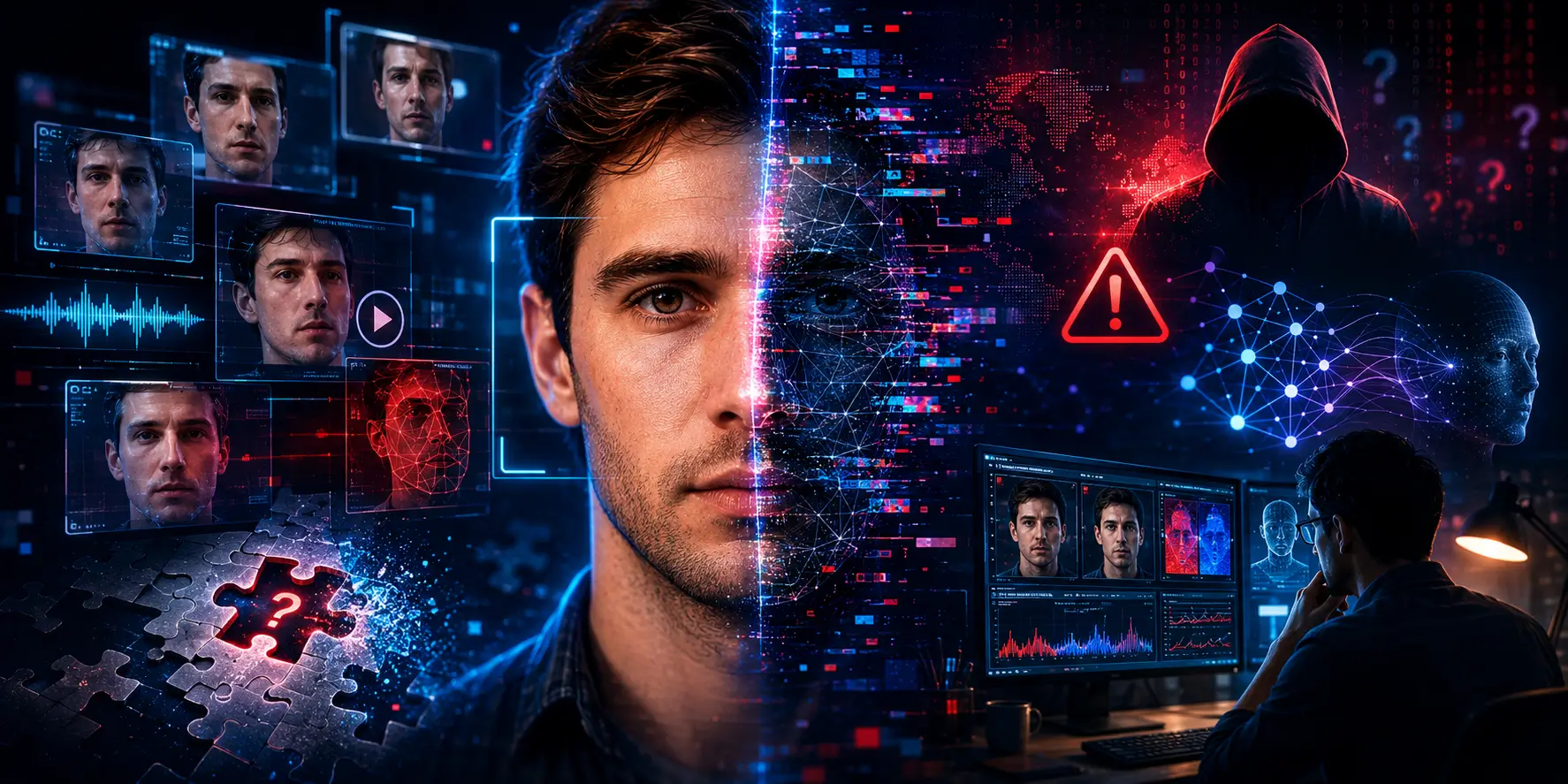
Deepfakes have evolved from internet curiosities into one of the most significant cybersecurity and digital trust challenges of the AI era. In just a few years, synthetic media has become so realistic that even trained professionals often struggle to distinguish fake videos from authentic ones. Reports estimate that the number of deepfake files online has grown from approximately 500,000 in 2023 to nearly 8 million by 2025, representing an increase of more than 1,500%. At the same time, deepfake-enabled fraud continues to rise, affecting businesses, governments, financial institutions, and individuals worldwide.
Modern deepfakes are no longer limited to face swaps. Today’s generative AI models can clone voices, generate realistic facial expressions, recreate body movements, and even fabricate entire conversations. As AI-generated content becomes increasingly accessible, organizations require reliable methods to verify digital authenticity before making critical decisions.
Fortunately, deepfake detection technology has advanced just as rapidly. Computer Vision (CV), Large Language Models (LLMs), Vision Transformers, multimodal AI, and biological signal analysis are enabling machines to detect manipulation that humans simply cannot see.
This guide explains how modern AI systems identify deepfakes, explores the latest detection techniques, reviews leading tools available in 2026, and discusses what the future holds for AI-powered media verification.
Key Takeaways
- Deepfake generation is improving rapidly, making manual detection increasingly difficult.
- Computer Vision models analyze subtle visual inconsistencies invisible to humans.
- Vision Transformers outperform many traditional CNN models on complex manipulations.
- Multimodal AI combines images, text, audio, and contextual understanding for higher detection accuracy.
- Explainable AI models now provide reasons behind their predictions, increasing trust.
- Organizations should combine multiple detection techniques rather than relying on a single model.
What Are Deepfakes?

Deepfakes are AI-generated or AI-manipulated media that imitate real people. Using deep learning models such as Generative Adversarial Networks (GANs) and diffusion models, attackers can create convincing videos, images, or audio recordings that appear authentic.
Common types of deepfakes include:
- Face replacement
- Face reenactment
- Voice cloning
- AI-generated avatars
- Lip synchronization
- Entirely synthetic videos
Although deepfake technology has legitimate uses in entertainment, education, gaming, and filmmaking, it also presents significant risks. Fraudsters can impersonate executives, manipulate political messages, spread misinformation, bypass biometric authentication systems, and conduct sophisticated social engineering attacks.
As generative AI models continue improving, distinguishing authentic content from synthetic media becomes increasingly challenging without automated detection systems.
Why Is Deepfake Detection So Difficult?
Today’s AI generators produce highly detailed facial textures, realistic lighting, natural eye movements, and convincing lip synchronization. Many traditional visual artifacts that earlier detection systems relied upon have disappeared.
Several factors contribute to the difficulty:
- Better generative models
- High-resolution outputs
- Improved temporal consistency
- Natural facial expressions
- Advanced lighting simulation
- High-quality voice synthesis
Furthermore, many detection models perform exceptionally well on laboratory datasets but experience noticeable performance degradation when exposed to real-world content from social media platforms, compressed videos, and mobile devices.
This ongoing “arms race” between deepfake generation and detection continues to push AI research forward.
Computer Vision Techniques Used for Deepfake Detection

1. CNN-Based Detection
Convolutional Neural Networks (CNNs) remain one of the most widely used approaches for identifying manipulated media.
CNNs analyze thousands of local image features, searching for inconsistencies that humans rarely notice.
Examples include:
- unnatural skin textures
- distorted teeth
- inconsistent ear structures
- abnormal reflections
- blurred boundaries
- pixel-level artifacts
Popular CNN architectures include:
- EfficientNet
- ResNeXt
- XceptionNet
- FaceForensics++ baseline
Think of CNNs as expert forensic investigators examining every pixel for hidden evidence.
Although CNNs remain highly effective, they sometimes struggle with previously unseen manipulation methods.
2. Vision Transformers (ViTs)
Vision Transformers have transformed computer vision by analyzing images as collections of interconnected patches rather than isolated pixels.
Instead of focusing only on facial regions, ViTs evaluate relationships across the entire image.
Advantages include:
- Better global context understanding
- Improved robustness
- Stronger generalization
- Better lighting analysis
- Detection beyond facial regions
Vision Transformers are particularly useful when manipulations extend into backgrounds, clothing, or surrounding environments.
3. Frequency Domain Analysis
Every AI image generator leaves behind subtle mathematical fingerprints that remain invisible to the human eye.
Frequency-domain detection transforms images into mathematical representations using techniques such as:
- Fast Fourier Transform (FFT)
- Discrete Cosine Transform (DCT)
- Wavelet analysis
These approaches identify repetitive synthetic patterns generated during image creation.
Even when visual quality appears perfect, hidden frequency anomalies often reveal AI-generated content.
4. Biological Signal Detection
Humans exhibit tiny skin color fluctuations caused by blood circulation.
These changes—known as remote photoplethysmography (rPPG)—are extremely difficult for AI generators to replicate accurately.
Systems such as Intel FakeCatcher analyze:
- pulse consistency
- skin color variation
- heartbeat synchronization
- physiological signals
This makes biological signal detection especially effective for identifying realistic face videos.
How Large Language Models Improve Deepfake Detection
Modern deepfake detection extends beyond visual analysis.
Large Language Models now work alongside computer vision systems to improve reasoning, explainability, and multimodal understanding.
CLIP-Based Detection

CLIP compares images with semantic descriptions.
Instead of simply classifying “real” or “fake,” CLIP evaluates whether visual content matches expected contextual information.
This enables strong zero-shot detection capabilities without extensive retraining.
Explainable AI
New research models generate natural-language explanations.
Example:
“The eye reflections are inconsistent with surrounding lighting conditions.”
Such explanations improve trust for:
- legal investigations
- enterprise audits
- compliance reporting
- digital forensics
Multimodal AI
Modern systems combine:
- video
- images
- audio
- metadata
- speech transcripts
- contextual reasoning
This holistic approach significantly improves robustness against sophisticated attacks.
Best Deepfake Detection Tools in 2026
| Tool | Best For | Key Strength |
| Intel FakeCatcher | Video authentication | Biological signal detection |
| Reality Defender | Enterprise security | Real-time monitoring |
| Hive Moderation | Content moderation | API integration |
| Sensity AI | Fraud detection | Enterprise intelligence |
| CLIP-based research models | Academic research | Zero-shot detection |
Organizations often combine multiple solutions depending on their workflow and security requirements.
Accuracy Comparison
| Detection Method | Strength | Weakness |
| CNN | Excellent pixel analysis | Limited generalization |
| Vision Transformer | Strong contextual understanding | Computationally intensive |
| Frequency Analysis | Detects hidden patterns | Sensitive to compression |
| Biological Signals | Difficult to fool | Video only |
| Multimodal AI | Highest overall accuracy | Higher computational cost |
Future of Deepfake Detection
The future of deepfake detection will focus on:
- On-device AI verification
- Digital content authenticity standards
- Cryptographic watermarking
- Explainable AI
- Real-time social media moderation
- Improved multimodal reasoning
- Global regulatory frameworks
Rather than relying solely on reactive detection, future systems will increasingly verify authenticity at the point of content creation.
Conclusion
Deepfakes are becoming more sophisticated every year, making reliable detection an essential capability for businesses, governments, and individuals. Computer Vision continues to serve as the foundation of modern deepfake detection, while Vision Transformers, multimodal AI, and Large Language Models significantly improve accuracy and explainability.
No single approach is sufficient on its own. The most effective solutions combine multiple detection techniques, continuously update their models, and integrate human expertise when necessary. As AI-generated media continues to evolve, organizations that invest in advanced detection technologies today will be better prepared to protect digital trust in the years ahead.
Frequently Asked Questions
1. What is deepfake detection?
Deepfake detection is the process of identifying AI-generated or manipulated images, videos, or audio using machine learning, computer vision, and multimodal AI techniques.
2. Can AI accurately detect deepfakes?
Yes. Modern AI systems can achieve high accuracy under controlled conditions. However, performance varies depending on the quality of the manipulated content and the detection method used.
3. Which technology is best for detecting deepfakes?
The most reliable solutions combine CNNs, Vision Transformers, biological signal analysis, and multimodal AI rather than relying on a single technique.
4. Is there a free deepfake detector?
Several academic and open-source projects offer free detection tools, while enterprise-grade platforms provide more advanced capabilities for commercial use.
5. Why are Large Language Models useful for deepfake detection?
LLMs improve explainability by describing why content appears manipulated and can combine visual, textual, and contextual information for more informed decisions.