
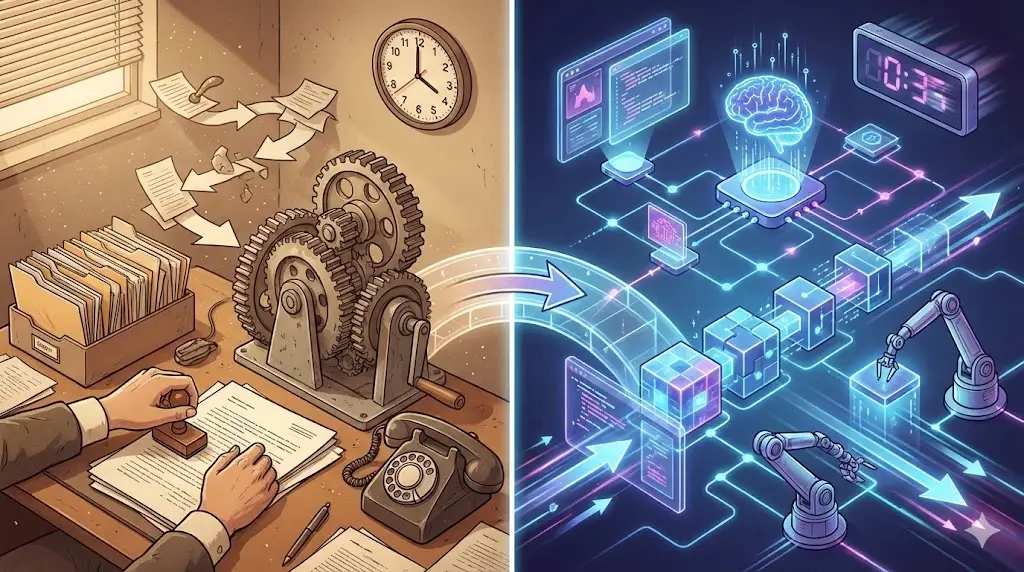
In today’s fast-moving digital economy, businesses are constantly under pressure to operate faster, smarter, and more efficiently. Traditional manual processes that once served organizations well are now struggling to keep pace with growing customer demands, data volumes, and competitive expectations. This is where AI Automation is rapidly redefining how modern workflows function.
From finance and marketing to customer service and operations, the shift from human-dependent workflows to intelligent automation is no longer optional—it’s a strategic necessity. In this blog, we will take a detailed look at manual workflows versus AI-driven workflows and help you understand which approach is better suited for long-term business success.
What Is Manual Workflow Management?
Manual workflow management refers to business processes that are executed by humans without the support of advanced automation tools. These processes rely heavily on employee effort for tasks such as data entry, approvals, reporting, customer communication, and document handling.
While manual workflows allow flexibility and direct human control, they also come with several inherent challenges:
- High dependency on workforce availability
- Time-consuming manual processes
- Increased chances of human errors
- Poor scalability as operations grow
- Higher long-term operational costs
In a business environment driven by speed and data accuracy, these limitations make manual workflow management increasingly difficult to sustain.
What Is AI Automation?
AI automation refers to the use of artificial intelligence combined with automation technologies to execute tasks that traditionally require human intelligence. Unlike basic rule-based automation, AI-powered automation systems can:
- Learn from data
- Detect patterns
- Adapt to changing conditions
- Make intelligent decisions
For example, AI systems can automatically route support tickets, detect fraud in finance, personalize marketing campaigns, or generate performance reports.
Studies show automation can significantly reduce repetitive work and increase productivity. Some organizations report up to 20–30% productivity improvement after automating processes.
This explains why AI adoption is accelerating across industries.
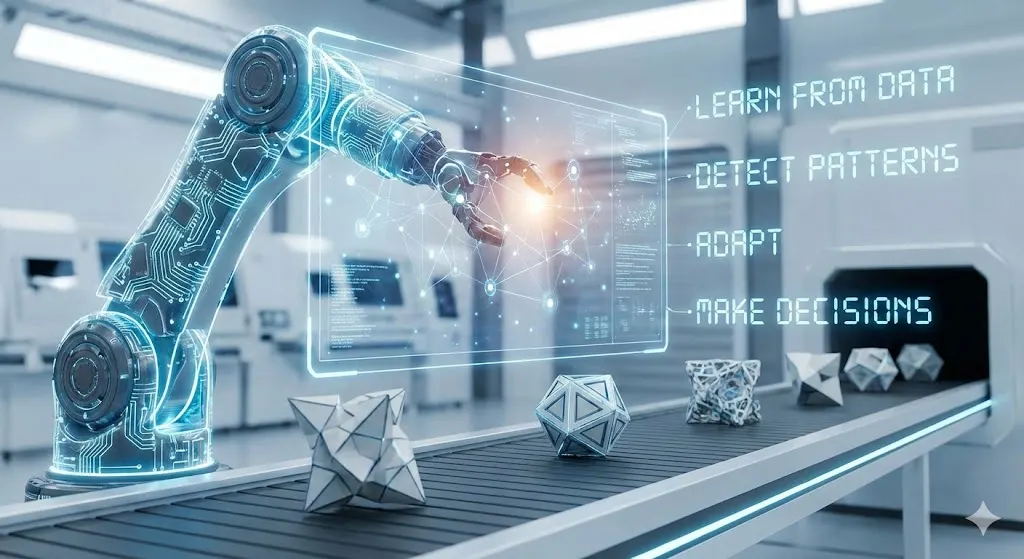
This includes technologies such as machine learning automation, intelligent process automation, robotic process automation (RPA), and AI-powered workflow systems. Together, these enable businesses to achieve real-time automation systems with minimal human intervention.
Key Differences Between Manual and AI Automation
| Factor | Manual Workflows | AI Automation |
|---|---|---|
| Speed | Slow and labor-intensive | Real-time automation |
| Accuracy | Error-prone human workflows | High data accuracy and consistency |
| Cost | Rising long-term manpower costs | Reduced operational costs |
| Scalability | Limited business scalability | Scalable automation frameworks |
| Decision Making | Human judgment only | Data-driven and automated decision-making |
| Availability | Business hours only | 24/7 workflow execution |
This comparison clearly shows why AI automation benefits far outweigh traditional manual methods for most modern businesses.
Challenges of Manual Workflows in Modern Businesses
Even today, many organizations continue to rely on manual processes for critical operations. While this may seem familiar and controllable, it introduces several operational risks:
- Delays in approvals and customer responses
- Inconsistent workflow execution
- Rework caused by data entry mistakes
- Lack of standardization across departments
- Difficulty maintaining compliance and audits
As organizations scale, these issues multiply and directly impact operational efficiency and customer satisfaction.
Benefits of AI Automation for Businesses
The adoption of AI-powered automation is transforming how companies approach operations, productivity, and growth. Some of the most impactful benefits include:
1. Automated Business Processes
AI seamlessly handles repetitive, rule-based, and data-heavy tasks, enabling end-to-end automation across departments.
2. Reduced Operational Costs
By minimizing human intervention, businesses significantly cut errors, rework, and labor dependency.
3. Improved Productivity and Efficiency
AI-driven workflows eliminate bottlenecks and ensure faster turnaround times.
4. Data-Driven Decision Making
Real-time insights and predictive analytics enable smarter strategic business choices.
5. 24/7 Workflow Execution
Unlike human teams, AI systems work continuously without fatigue or downtime.
These advantages make AI and automation essential for sustainable digital transformation.
Real-World Use Cases of AI Automation
AI automation is no longer limited to large enterprises. It is now widely adopted across industries:
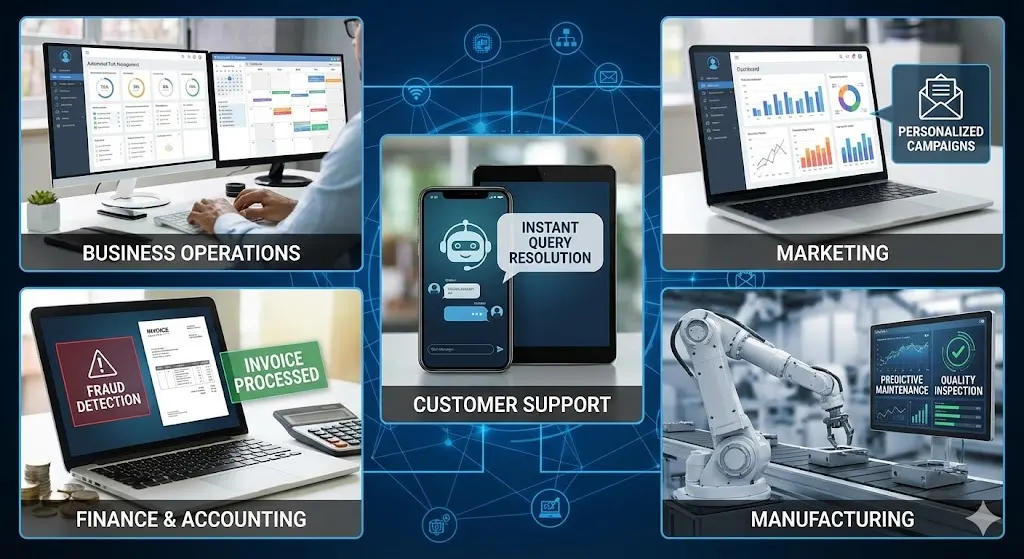
AI in Business Operations
Companies use automated task management systems to handle scheduling, reporting, and internal operations efficiently.
Finance & Accounting
AI process automation handles invoice processing, fraud detection, and reconciliation with higher accuracy.
Customer Support
AI chatbots and virtual assistants provide instant query resolution using NLP and conversational AI.
Marketing
AI marketing automation helps personalize content, automate campaigns, and boost lead conversion rates.
Manufacturing
Smart workflow systems improve supply chain visibility, predictive maintenance, and quality inspections.
These real-world implementations prove how AI-powered automation upgrades every aspect of business operations.
AI Automation and Business Scalability
Scalability is one of the strongest advantages of intelligent automation. As transaction volumes and customer demands increase, AI adapts without requiring proportional expansion in manpower.
Businesses benefit through:
- Enterprise automation at scale
- Workflow optimization tools
- Seamless ERP and CRM integration
- Technology-enabled workflows
With AI workflow automation, companies gain the flexibility to grow without increasing operational chaos.
Automation vs Human Labor: A Smarter Balance
One of the biggest misconceptions is that automation completely replaces humans. In reality, the most successful organizations follow a hybrid approach.
- AI manages repetitive and data-heavy tasks
- Human teams focus on strategy, creativity, and critical thinking
- Minimum human intervention ensures efficiency without losing control
This balance ensures businesses leverage intelligence automation while preserving the human element where it matters most.
How AI Automation Drives Digital Transformation
Digital transformation is no longer about simply moving online. It is about creating technology-led operations that are intelligent, scalable, and data-first.
AI automation enables:
- Workflow digitization across departments
- Intelligent process automation
- Automation-driven performance improvements
- Smarter customer experiences
- Future-ready organizations
By embedding AI into daily operations, companies achieve true AI-powered business transformation.
Why Choose A3 Bees Innovations for AI Automation?
A3 Bees Innovations is a trusted AI technology partner helping businesses worldwide unlock the full potential of automation. With deep expertise across artificial intelligence, computer vision, data annotation, NLP, and generative AI, A3 Bees delivers scalable and secure automation solutions.
What Sets A3 Bees Apart?
- End-to-End AI Automation Solutions: From strategy to deployment
- Enterprise-Ready Architecture: Built for performance and scalability
- Secure & NDA-Compliant Delivery: Strict data security standards
- Industry-Specific Expertise: Healthcare, retail, manufacturing, finance, and more
- Agile Development & 24/7 Support: Rapid delivery with continuous optimization
Whether you need AI-powered workflow systems, intelligent business automation, or predictive automation solutions, A3 Bees ensures measurable business outcomes.
Ready to automate smarter and scale faster?
Contact A3 Bees Innovations at [email protected] to transform your workflows today.
Conclusion: Manual vs AI Automation – The Final Verdict
While manual workflows are still relevant in creative and sensitive tasks, they fall short when it comes to speed, scalability, and consistency. On the other hand, AI automation empowers businesses with intelligent decision-making, real-time execution, and data-driven performance.
Organizations that invest in automation today position themselves as leaders of tomorrow. The future belongs to businesses that combine human intelligence with AI-powered efficiency.
FAQs
1. What is AI automation in simple terms?
AI automation is the use of artificial intelligence to automate tasks that normally require human effort and decision-making.
2. Is AI automation expensive to implement?
With scalable cloud-based tools, AI automation is now affordable for small, medium, and large businesses.
3. Can AI automation replace human employees?
AI supports employees by handling repetitive tasks while humans focus on higher-value responsibilities.
4. How long does it take to implement AI automation?
Depending on workflow complexity, implementation can take from a few weeks to a few months.
5. How does A3 Bees Innovations help in AI automation?
A3 Bees offers end-to-end AI solutions including business automation, chatbots, NLP, computer vision, and enterprise AI systems.